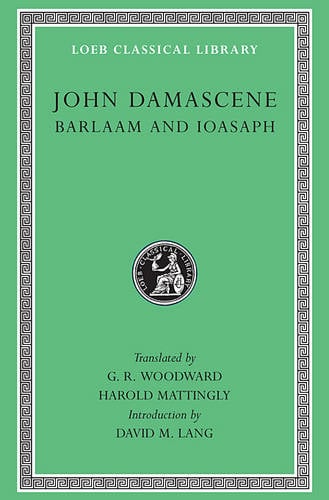
Barlaam and Ioasaph by John John Damascene (Hardcover)
- livro usadoISBN: 9780674990388
A princely tale inspired by Christianity and Buddhism. One of the best known examples of the hagiographic novel, this is the tale of an Indian prince who becomes aware of the world's mise… mais…
A princely tale inspired by Christianity and Buddhism. One of the best known examples of the hagiographic novel, this is the tale of an Indian prince who becomes aware of the world's miseries and is converted to Christianity by the monk Barlaam. Barlaam and Josaphat (Ioasaph) were believed to have re-converted India after her lapse from conversion to Christianity, and they were numbered among the Christian saints. Centuries ago likenesses were noticed between the life of Josaphat and the life of the Buddha; the resemblances are in incidents, doctrine, and philosophy, and Barlaam's rules of abstinence resemble the Buddhist monk's. But not till the mid-nineteenth century was it recognized that, in Josaphat, the Buddha had been venerated as a Christian saint for about a thousand years. The origin of the story of Barlaam and Ioasaph--which in itself has little peculiar to Buddhism--appears to be a Manichean tract produced in Central Asia. It was welcomed by the Arabs and by the Georgians. The Greek romance of Barlaam appears separately first in the 11th century. Most of the Greek manuscripts attribute the story to John the Monk, and it is only some later scribes who identify this John with John Damascene (ca. 676-749). There is strong evidence in Latin and Georgian as well as Greek that it was the Georgian Euthymius (who died in 1028) who caused the story to be translated from Georgian into Greek, the whole being reshaped and supplemented. The Greek romance soon spread throughout Christendom, and was translated into Latin, Old Slavonic, Armenian, and Arabic. An English version (from Latin) was used by Shakespeare in his caskets scene in The Merchant of Venice . David M. Lang's Introduction traces parallels between the Buddhist and Christian legends, discusses the importance of Arabic versions, and notes influences of the Manichean creed. Non-Fiction > Literary Collections > Ancient & Classical,Non-Fiction > Literary Collections > Buddhism,Non-Fiction > Literary Collections > Christianity,Non-Fiction > Literary Collections > Fairy Tales,Folk Tales,Legends & Mythology,Non-Fiction > Religion, John John Damascene<
| | BetterWorldBooks.comused in stock. Custos de envio:zzgl. Versandkosten., mais custos de envio Details... |
(*) Livro esgotado significa que o livro não está disponível em qualquer uma das plataformas associadas buscamos.

Barlaam and Ioasaph (Loeb Classical Library) by St.John Damascene,
- nuovo livroISBN: 9780674990388
One of the best known examples of the hagiographic novel, this is the tale of an Indian prince who becomes aware of the world's miseries and is converted to Christianity by the monk Barla… mais…
One of the best known examples of the hagiographic novel, this is the tale of an Indian prince who becomes aware of the world's miseries and is converted to Christianity by the monk Barlaam. Barlaam and Josaphat (Ioasaph) were believed to have re-converted India after her lapse from conversion to Christianity, and they were numbered among the Christian saints. Centuries ago likenesses were noticed between the life of Josaphat and the life of the Buddha; the resemblances are in incidents, doctrine, and philosophy, and Barlaam's rules of abstinence resemble the Buddhist monk's. But not till the mid-nineteenth century was it recognised that, in Josaphat, the Buddha had been venerated as a Christian saint for about a thousand years.The origin of the story of Barlaam and Ioasaph?which in itself has little peculiar to Buddhism?appears to be a Manichaean tract produced in Central Asia. It was welcomed by the Arabs and by the Georgians. The Greek romance of Barlaam appears separately first in the 11th century. Most of the Greek manuscripts attribute the story to John the Monk, and it is only some later scribes who identify this John with John Damascene (ca. 676?749). There is strong evidence in Latin and Georgian as well as Greek that it was the Georgian Euthymius (who died in 1028) who caused the story to be translated from Georgian into Greek, the whole being reshaped and supplemented. The Greek romance soon spread throughout Christendom, and was translated into Latin, Old Slavonic, Armenian, and Arabic. An English version (from Latin) was used by Shakespeare in his caskets scene in The Merchant of Venice.David M. Lang's Introduction traces parallels between the Buddhist and Christian legends, discusses the importance of Arabic versions, and notes influences of the Manichaean creed., von Profianbieter, Neu, Festpreisangebot, [LT: FixedPrice], EAN: 9780674990388, UPC: 9780674990388, Format: Hardback, 688 pages, Breite: 11.7 cm, Gewicht: 0.38 kg, Höhe: 4.1 cm, Länge: 16.3 cm, Sprache: Eng, [PU: Harvard University Press]<
| | ebay.deloveourprices2 95.9, Zahlungsarten: Andere, Bar, Paypal, Kreditkarte, Visa, Mastercard, DINERS_CLUB. Custos de envio:Versandkostenfrei, Versand zum Fixpreis, [SHT: Standard Shipping from outside], GL3 *** Gloucester, [TO: Deutschland, Österreich] (EUR 0.00) Details... |
(*) Livro esgotado significa que o livro não está disponível em qualquer uma das plataformas associadas buscamos.

John Damascene:Barlaam and Ioasaph
- encadernada, livro de bolso 1914, ISBN: 0674990382
[EAN: 9780674990388], Neubuch, [PU: Harvard University Press, US], PHILOSOPHY AND SPIRITUALITY, A princely tale inspired by Christianity and Buddhism.One of the best known examples of the… mais…
[EAN: 9780674990388], Neubuch, [PU: Harvard University Press, US], PHILOSOPHY AND SPIRITUALITY, A princely tale inspired by Christianity and Buddhism.One of the best known examples of the hagiographic novel, this is the tale of an Indian prince who becomes aware of the world's miseries and is converted to Christianity by the monk Barlaam. Barlaam and Josaphat (Ioasaph) were believed to have re-converted India after her lapse from conversion to Christianity, and they were numbered among the Christian saints. Centuries ago likenesses were noticed between the life of Josaphat and the life of the Buddha; the resemblances are in incidents, doctrine, and philosophy, and Barlaam's rules of abstinence resemble the Buddhist monk's. But not till the mid-nineteenth century was it recognized that, in Josaphat, the Buddha had been venerated as a Christian saint for about a thousand years.The origin of the story of Barlaam and Ioasaph-which in itself has little peculiar to Buddhism-appears to be a Manichean tract produced in Central Asia. It was welcomed by the Arabs and by the Georgians. The Greek romance of Barlaam appears separately first in the 11th century. Most of the Greek manuscripts attribute the story to John the Monk, and it is only some later scribes who identify this John with John Damascene (ca. 676-749). There is strong evidence in Latin and Georgian as well as Greek that it was the Georgian Euthymius (who died in 1028) who caused the story to be translated from Georgian into Greek, the whole being reshaped and supplemented. The Greek romance soon spread throughout Christendom, and was translated into Latin, Old Slavonic, Armenian, and Arabic. An English version (from Latin) was used by Shakespeare in his caskets scene in The Merchant of Venice. David M. Lang's Introduction traces parallels between the Buddhist and Christian legends, discusses the importance of Arabic versions, and notes influences of the Manichean creed., Books<
| | AbeBooks.deRarewaves.com USA, London, LONDO, United Kingdom [89806455] [Rating: 5 (von 5)] NEW BOOK. Custos de envio: EUR 2.27 Details... |
(*) Livro esgotado significa que o livro não está disponível em qualquer uma das plataformas associadas buscamos.

John Damascene:Barlaam and Ioasaph
- encadernada, livro de bolso ISBN: 9780674990388
A princely tale inspired by Christianity and Buddhism.One of the best known examples of the hagiographic novel, this is the tale of an Indian prince who becomes aware of the world’s miser… mais…
A princely tale inspired by Christianity and Buddhism.One of the best known examples of the hagiographic novel, this is the tale of an Indian prince who becomes aware of the world’s miseries and is converted to Christianity by the monk Barlaam. Barlaam and Josaphat (Ioasaph) were believed to have re-converted India after her lapse from conversion to Christianity, and they were numbered among the Christian saints. Centuries ago likenesses were noticed between the life of Josaphat and the life of the Buddha; the resemblances are in incidents, doctrine, and philosophy, and Barlaam’s rules of abstinence resemble the Buddhist monk’s. But not till the mid-nineteenth century was it recognized that, in Josaphat, the Buddha had been venerated as a Christian saint for about a thousand years.The origin of the story of Barlaam and Ioasaph—which in itself has little peculiar to Buddhism—appears to be a Manichean tract produced in Central Asia. It was welcomed by the Arabs and by the Georgians. The Greek romance of Barlaam appears separately first in the 11th century. Most of the Greek manuscripts attribute the story to John the Monk, and it is only some later scribes who identify this John with John Damascene (ca. 676–749). There is strong evidence in Latin and Georgian as well as Greek that it was the Georgian Euthymius (who died in 1028) who caused the story to be translated from Georgian into Greek, the whole being reshaped and supplemented. The Greek romance soon spread throughout Christendom, and was translated into Latin, Old Slavonic, Armenian, and Arabic. An English version (from Latin) was used by Shakespeare in his caskets scene in The Merchant of Venice.David M. Lang’s Introduction traces parallels between the Buddhist and Christian legends, discusses the importance of Arabic versions, and notes influences of the Manichean creed. Books John Damascene|Hardback|Harvard University Press|01/01/1914, Harvard University Press<
| | Waterstones.comNr. 9780674990388. Custos de envio:, , zzgl. Versandkosten., mais custos de envio Details... |
(*) Livro esgotado significa que o livro não está disponível em qualquer uma das plataformas associadas buscamos.
John Damascene John Damascene|G. R. Woodward|Harold Mattingly|David M. Lang:Barlaam and Ioasaph
- encadernada, livro de bolso 1989, ISBN: 0674990382
[EAN: 9780674990388], Neubuch, [SC: 0.0], [PU: Harvard University Press], POETRY ANCIENT & CLASSICAL, Barlaam and Ioasaph, a hagiographic novel in which an Indian prince becomes aware of … mais…
[EAN: 9780674990388], Neubuch, [SC: 0.0], [PU: Harvard University Press], POETRY ANCIENT & CLASSICAL, Barlaam and Ioasaph, a hagiographic novel in which an Indian prince becomes aware of the world s miseries and is converted to Christianity by a monk, is a Christianized version of the legend of the Buddha. Though often attributed to John Damascene (c. 676-7., Books<
| | ZVAB.commoluna, Greven, Germany [73551232] [Rating: 4 (von 5)] NEW BOOK. Custos de envio:Versandkostenfrei. (EUR 0.00) Details... |
(*) Livro esgotado significa que o livro não está disponível em qualquer uma das plataformas associadas buscamos.